
Hashtag Generator
Random hashtag generators throw out long lists of popular tags, but the hashtags that work are specific to your topic, audience and platform. These templates help you build and reuse your own sets: research candidate hashtags, group them by topic and reach, rotate them across a content calendar and record what performs — using the analytics your platform already gives you.
- Instant download
- Editable Excel & Word
- Print-ready PDF
- 7-day refund
5 files · XLSX, PDF, DOCX
Hashtag Planning Template Pack
Hashtag research workbook, hashtag bank, content calendar with hashtag sets, performance tracker and a printable method and platform notes sheet.
- Research workbook (XLSX)
- Hashtag bank (XLSX)
- Content calendar (PDF/DOCX/XLSX)
- + 2 more
$5.00 USD, one-time 5 files · about $1.00 each
- Instant download
- 7-day refund
- Secure checkout by Stripe
7-day money-back guarantee. Full refund within 7 days of purchase, even after you download.
Free sample: Hashtag Research (PDF, 69 KB)
Hashtag Planning Template Pack
Hashtag research workbook, hashtag bank, content calendar with hashtag sets, performance tracker and a printable method and platform notes sheet.
- Research workbook (XLSX)
- Hashtag bank (XLSX)
- Content calendar (PDF/DOCX/XLSX)
- Performance tracker (XLSX)
- Method sheet (PDF/DOCX)
Formats: XLSX, PDF, DOCX. Instant download after payment (link valid 72 hours, up to 5 downloads). AI-assisted: the templates were drafted with AI help and reviewed and laid out before publishing.
$5.00 USD, one-time 5 files · about $1.00 each
- Instant download
- 7-day refund
- Secure checkout by Stripe
7-day money-back guarantee. Full refund within 7 days of purchase, even after you download.
Free sample: Hashtag Research (PDF, 69 KB)
Full refund within 7 days — see the refund policy and license.
Free printables
Single sheets you can print right now, no sign-up. The full pack adds every sheet in one download plus the editable files.
 Printable Hashtag Research Workbook
 Printable Hashtag Bank Sheet
 Printable Content Calendar with Hashtags
 Hashtag Performance Tracker
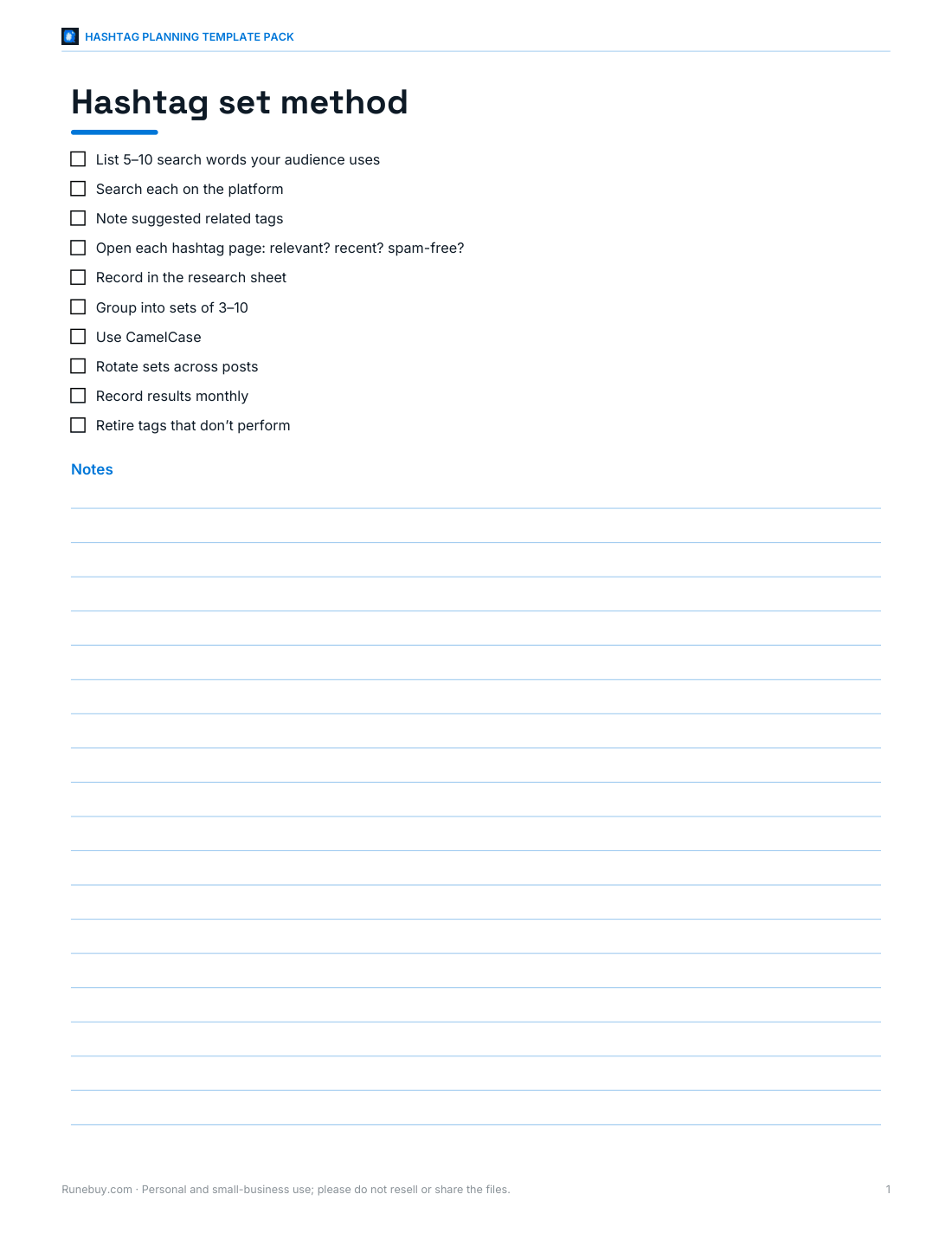
 Printable Hashtag Set Method Sheet
How hashtags work today
On most platforms, hashtags are one signal among many that help content get categorised and discovered — through hashtag pages, search and topic recommendations. They work best when they accurately describe the post. Platforms change their guidance over time; for example, Instagram has suggested using a small number of relevant hashtags rather than filling the maximum allowed. Check each platform’s current help pages rather than relying on old rules of thumb.
Types of hashtag
| Type | Example | Use |
|---|---|---|
| Topic / niche | #sourdoughbaking | Describes what the post is about |
| Community | #bookstagram | Joins an established community |
| Location | #portlandoregon | Local discovery |
| Branded | #yourbrandname | Collects your own content and user posts |
| Campaign / event | #yourlaunch2026 | Tracks a specific campaign |
| Descriptive | #rainyday | Mood or context |
A balanced set usually mixes a few specific niche tags with one or two broader ones and, where relevant, a location or branded tag.
A method for building hashtag sets
- List five to ten words your audience would actually search for about your topic.
- Search each on the platform and note related tags it suggests.
- Open each hashtag page: are the top posts similar to yours? Is the content spam-free and recent?
- Record the tag in the research sheet with its topic, relevance and size (small, medium or large — as shown by the platform, where available).
- Group tags into sets of three to ten by topic.
- Rotate sets across posts and record results in the tracker.
The research workbook has columns for each step, so you build a bank of vetted hashtags instead of starting from scratch each time.
Platform notes
| Platform | Where hashtags go | Practical approach |
|---|---|---|
| Caption or first comment | A few highly relevant tags; up to the platform limit | |
| TikTok | Caption | A few specific tags; descriptive captions matter too |
| End of post | Around three professional topic tags | |
| X (Twitter) | In or after the text | One or two, if any |
| YouTube | Title or description | A few tags; the first may show above the title |
| Description | Keywords in descriptions matter more than hashtags |
Limits and features change — confirm the current rules in each platform’s help centre.
Worked example
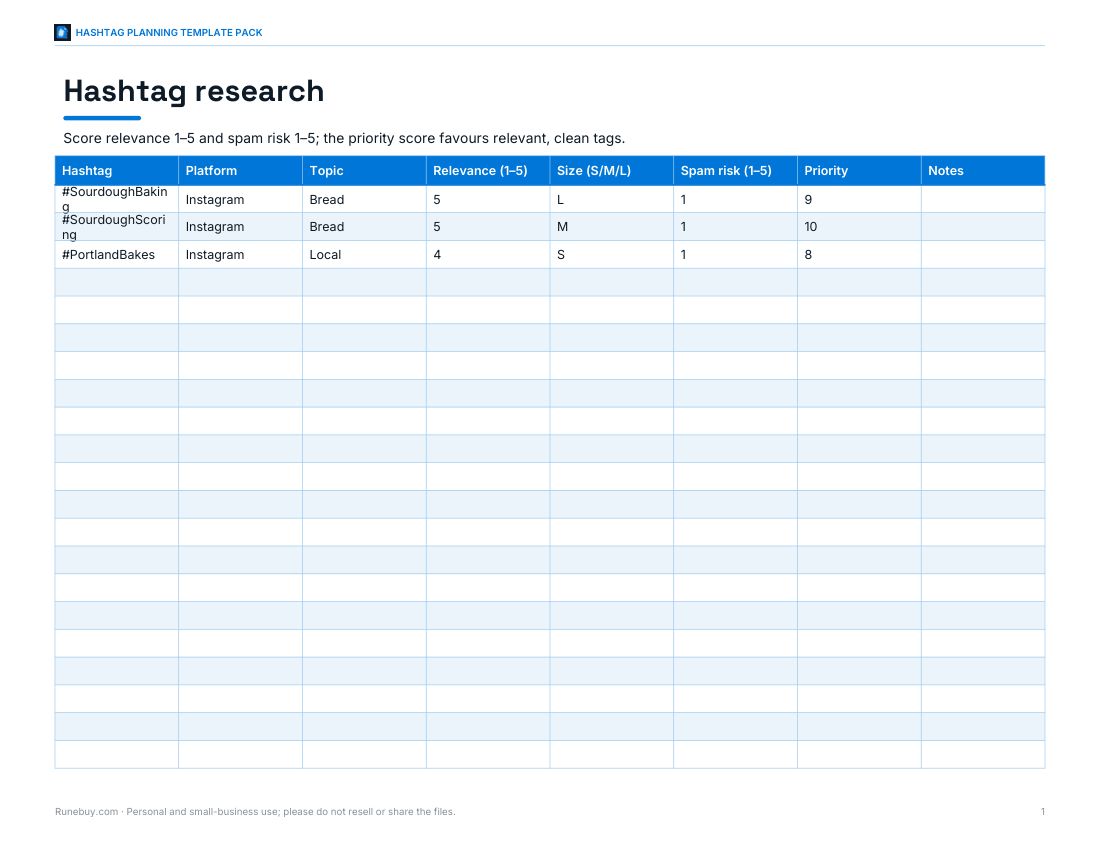
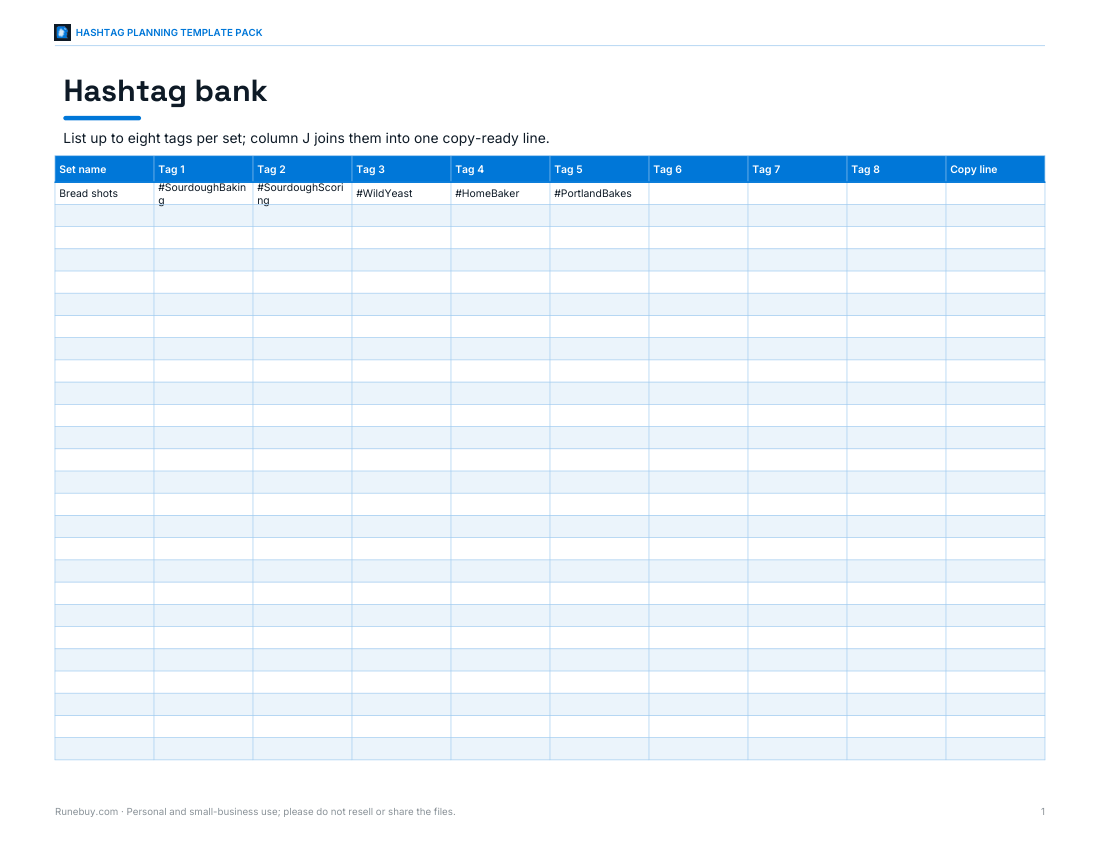
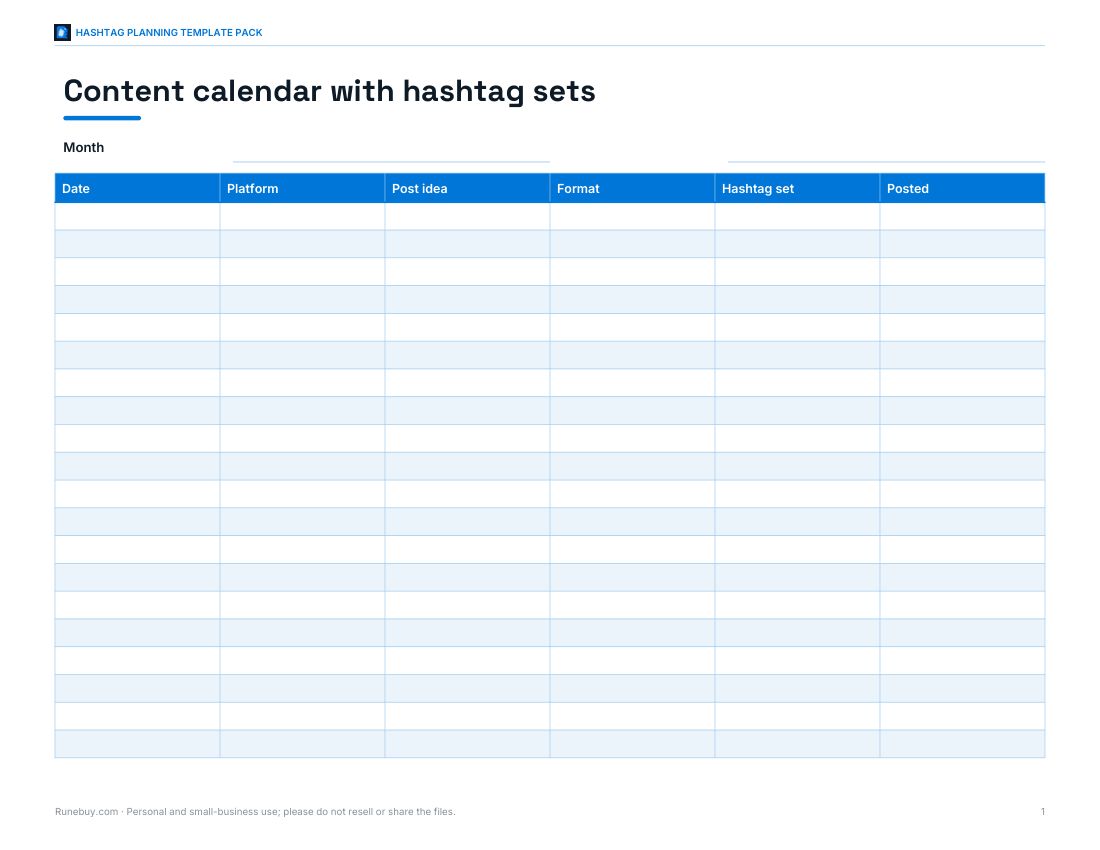
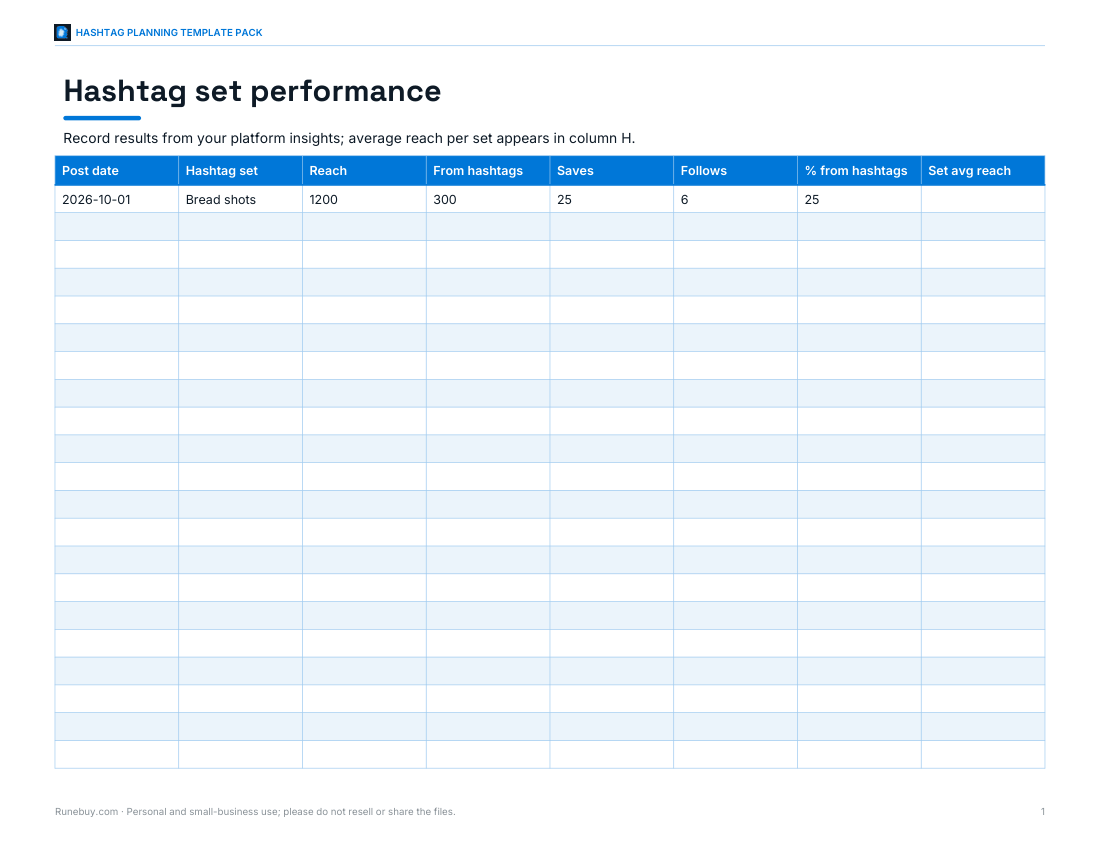
A home baker posting sourdough photos researches candidates: #sourdough (very large, general), #sourdoughbaking (large), #sourdoughscoring (medium, specific), #homebaker (large), #wildyeast (medium) and #portlandbakes (small, local). In the workbook she groups them into two sets: “Bread shots” (#sourdoughbaking, #sourdoughscoring, #wildyeast, #homebaker, #portlandbakes) and “Process videos” (#sourdough, #breadmaking, #fermentation, #homebaker). Over a month she alternates the sets in the content calendar and records reach from the platform’s insights, then keeps the set that consistently brings in new followers.
Avoid these mistakes
- Using unrelated trending tags to get views — it attracts the wrong audience and can look spammy.
- Copy-pasting the same long block on every post.
- Tags that have been restricted or are full of spam — check the hashtag page first.
- Hashtags that are hard to read: capitalise words (#SourdoughBaking) for accessibility with screen readers.
- Forgetting to check a tag’s other meanings before using it.
What’s in the pack
- Hashtag research workbook (XLSX): candidate, platform, topic, relevance score, size, spam check, notes
- Hashtag bank (XLSX) grouped by set, with copy-ready rows
- Content calendar (XLSX and PDF) pairing each post with a hashtag set
- Performance tracker (XLSX) for reach, saves and follows by set
- Printable one-page method and platform notes
Spreadsheets open in Excel and Google Sheets; the PDF prints on US Letter and A4.
AI-assisted content
This page and the templates were drafted with AI assistance and reviewed before publishing. No follower or reach figures are promised; use your own platform analytics.
Frequently asked questions
How many hashtags should I use?
A few highly relevant hashtags usually work better than the maximum; check each platform’s current guidance.
Where do I find good hashtags?
Platform search suggestions, similar accounts in your niche, and hashtag pages whose top posts match your content.
Should I use popular hashtags?
Mix one or two broad tags with more specific niche tags.
Why capitalise hashtags?
CamelCase (#SourdoughBaking) is easier to read and works better with screen readers.
Can I reuse the same hashtags?
Yes, but rotate sets and match them to each post’s content.
Is this a subscription?
No, it is a one-time download.